

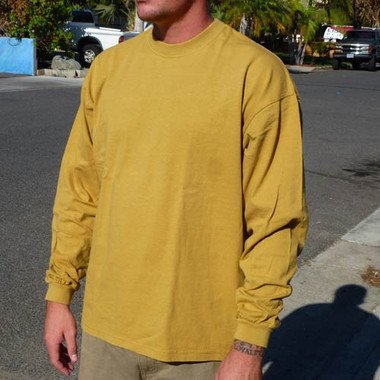
Heavyweight T-Shirt Sizing Guide: Why Traditional Sizes Don't Apply
Posted by Jay Durkee, Founder on Mar 26th 2026
If you've ever ordered a heavyweight t-shirt in your "usual size" only to find it fits completely differently than expected, you're not alone. The frustrating truth is that traditional t-shirt sizing—Small, Medium, Large, XL—means virtually nothing when comparing across brands, and it means even less when you're dealing with heavyweight construction.
Here's what most online shoppers don't realize: A Medium in a 4.5 oz lightweight shirt fits nothing like a Medium in a 7.5 oz heavyweight shirt. The extra fabric weight, different construction methods, and garment-dyeing processes fundamentally change how the shirt drapes, sits on your body, and feels when worn. Ordering your "usual size" without understanding these differences is basically guessing.
This guide will teach you exactly how to choose the right size in heavyweight t-shirts, why traditional sizing charts fail, and how to measure yourself properly so you never waste money on an ill-fitting shirt again. You will save money returning and exchanging as well.
Why Traditional T-Shirt Sizes Are Meaningless
Walk into any retail store and grab five "Large" t-shirts from five different brands. Measure them. You'll find chest widths ranging from 20 inches to 24 inches—a difference of four inches, or two full sizes. Now try them on. Some will fit like a Medium, others like an XL. Welcome to the chaos of modern apparel sizing.
The Vanity Sizing Problem
Retail brands have been inflating sizes for decades. What was called a Medium in the 1990s is now often labeled a Small. What was a Large is now a Medium. Brands do this to make customers feel better about their purchases—if you fit into a Medium instead of a Large, you're more likely to buy. The result? Size labels have become completely arbitrary.
Real example: A "Large" from a major fast-fashion retailer measures 40 inches around the chest. A "Large" from a premium heritage brand measures 46 inches. That's a six-inch difference for the same size label. One is actually a Medium, the other is actually an XL, but both say "Large" on the tag.
The Athletic Fit Explosion
Modern brands offer multiple fits within the same size: Classic, Slim, Athletic, Modern, Relaxed, Tailored. A Large Classic Fit and a Large Slim Fit from the same brand can differ by 3-4 inches in the chest. Which one is the "real" Large? Neither. Both. It doesn't matter—the label tells you nothing useful.
Why Heavyweight Makes It Worse
Heavyweight t-shirts add another layer of complexity. The extra fabric weight changes everything:
- Drape vs. Cling: Lightweight fabric clings to your body, conforming to your shape. Heavyweight fabric drapes away from your body with its own weight. A "tight" lightweight Medium might feel similar to a "loose" heavyweight Small because the heavyweight fabric doesn't cling.
- Stretch vs. Structure: Thin fabric stretches easily, so a slightly small shirt can still feel wearable. Heavyweight fabric has more structure and doesn't stretch as much, so sizing needs to be more precise.
- Garment-Dyed Shrinkage: If heavyweight shirts are garment-dyed (like ours), they've already completed their shrinkage during production. Standard shirts shrink after you buy them, so brands often size them larger to account for future shrinkage. This means a standard Medium and a garment-dyed Medium will fit differently even if they start at the same measurements.
- Construction Differences: Heavyweight shirts use thicker yarn (16-18 count vs. 30-40 count in lightweight), tighter knitting, and more substantial ribbing at collars and hems. All of this affects how the shirt sits on your body.
Bottom line: You cannot reliably order heavyweight t-shirts based on size labels alone. You need actual measurements.
How Heavyweight T-Shirts Fit Differently
Understanding these differences will change how you shop for quality t-shirts.
The Weight Changes Everything
| Factor | Lightweight (4-5 oz) | Heavyweight (7-8 oz) |
|---|---|---|
| Drape | Clings to body contours | Hangs with structure, skims body |
| Shoulder Seam | Sits exactly at shoulder point | Often drops slightly or purposly due to fabric weight |
| Sleeve Fall | Sleeves cling to arms | Sleeves are fuller & drape naturally, creating cleaner lines |
| Body Length | Rides up easily when moving | Stays in place due to weight |
| Fit Tolerance | Stretches to accommodate body | Less stretch, size must be accurate |
| Visual Weight | Looks thin, can appear clingy | Looks substantial, creates silhouette |
Real-World Fit Examples
Scenario 1: The Between-Sizes Dilemma
You measure 42 inches around the chest. A brand's Medium measures 40 inches (chest width 20" × 2), and their Large measures 44 inches (chest width 22" × 2). You're right between sizes.
In lightweight fabric: Buy the Medium. The thin fabric will stretch to accommodate your 42-inch chest, and the cling factor makes it work.
In heavyweight fabric: Buy the Large. Heavyweight fabric doesn't stretch as much, and you want the shirt to skim your body, not pull tight. The extra room lets the fabric drape properly.
Scenario 2: The Tall Customer
You're 6'3" with a 40-inch chest. A standard Large fits your chest but the body length is too short.
In lightweight fabric: You might size up to XL for length, accepting that the chest will be too big. The thin fabric drapes and gathers, hiding some excess width.
In heavyweight fabric: An XL sized for extra length will look boxy and oversized because heavyweight fabric doesn't gather—it hangs. You need a Tall Fit in a smaller size so the proportions work with the fabric weight. It is absolutely imperative that you easure and compare the fit chart.
Scenario 3: The Athletic Build
You have broad shoulders (48 inches) but a trim waist (32 inches).
In lightweight fabric: You might get away with a Large that's tight in the shoulders because the fabric stretches and conforms to your V-shape.
In heavyweight fabric: The Tees from Heayweight Collections will have a drop shoulder. The crew neck will be high and tight but will not conform to a V-shape, it will drape down to the hips. The size chart shows a size Large will have a 48 inch chest ( 24 x 2) so the shoulders will feel a little bigger. The fabric will not stretch out and will not shrink. You will want to measure in the indicated spots and buy the size that most closely matches your measurements.
How to Measure Yourself for Heavyweight T-Shirts
Forget guessing. Here's how to measure yourself accurately and compare to sizing charts with confidence.
What You'll Need
- Fabric measuring tape (or string and a ruler)
- A mirror (or someone to help)
- Your best-fitting t-shirt for reference
- A hard surface to lay the shirt flat
Body Measurements (Optional But Helpful)
Chest Circumference:
- Wrap the measuring tape around the fullest part of your chest (usually across nipples)
- Keep the tape parallel to the floor, not sagging in back
- Take a normal breath (don't puff out your chest or suck in)
- The tape should be snug but not tight—you should be able to slide one finger underneath
- Record the measurement in inches
Why this helps: If your chest measures 42 inches, you need a shirt with a chest measurement of at least 44 inches (2 inches of ease) for a fitted look, or 46-48 inches for a relaxed fit. In heavyweight fabric, err toward more ease.
Measuring Your Best-Fitting T-Shirt (Most Important)
This is the critical step most people skip. Your best-fitting shirt tells you exactly what measurements work for your body and preferences.
1. Chest Width (Armpit to Armpit):
- Lay the shirt flat on a table, front side up
- Smooth out any wrinkles
- Measure straight across from armpit seam to armpit seam
- Don't stretch the fabric—measure it relaxed
- Record this measurement
- Double it to get full chest circumference
Example: If you measure 22 inches across, the full chest is 44 inches.
2. Body Length (Shoulder to Hem):
- Lay the shirt flat
- Measure from the highest point of the shoulder (where collar attaches) straight down to the bottom hem
- Measure along the center of the shirt, not the side seam
- Record this measurement
Important for tall or short customers: If your favorite shirt's body length is 30 inches and you try a shirt that's 28 inches, it will feel short. Length matters more than most people realize, especially in heavyweight fabric that doesn't ride up.
3. Sleeve Length (Shoulder to Cuff):
- Measure from the shoulder seam straight down to the end of the sleeve
- Measure along the outside of the sleeve, following the seam
- Record this measurement
4. Shoulder Width (Seam to Seam):
- Measure straight across the back from shoulder seam to shoulder seam
- This should match approximately where your natural shoulder ends
- Record this measurement
Pro tip: In heavyweight shirts, shoulder seams will drop slightly (½ to 1 inch) due to fabric weight. This is normal and creates a relaxed look. Don't assume the seam must sit exactly at your shoulder point.
Comparing Your Measurements to Size Charts
Now you have four key measurements from your best-fitting shirt. Compare these to the brand's size chart:
Priority ranking:
- Chest width: Most important. Must be close (within 1 inch).
- Body length: Second most important. Can't be altered easily.
- Sleeve length: Matters if you care about sleeve fit (less critical for casual wear).
- Shoulder width: Less critical in heavyweight due to natural drape.
How to match:
- Exact match (within 0.5"): Order that size with confidence
- Between sizes: In heavyweight, size up for comfort - be sure to measure
- One dimension off: Prioritize chest width and length over sleeves/shoulders
- Nothing matches: Contact the brand or try a different fit (Classic vs. Pro)
Understanding Fit Styles: Classic, Pro, and Tall
At Heavyweight Collections, we offer three distinct fits because one size does NOT fit all—especially in heavyweight fabric. Here's how to choose.
Classic Fit: The Original Heavyweight Experience
Who it's for:
- Anyone who prefers a traditional, roomy t-shirt fit
- Customers who want maximum comfort and ease of movement
- People who layer shirts (heavyweight works great under jackets/flannels)
- Those who appreciate the relaxed California alifestyle look and feel
- Anyone buying their first heavyweight shirt (easiest to size)
Fit characteristics:
- Generous through chest and body (typically 2-3 inches more ease than fitted styles)
- Boxy silhouette—straight from chest to hem
- Sleeves are full and can end just above the bend of the elbow
- Shoulder seam drops slightly past natural shoulder due to design & fabric weight
- Works for most body types without looking oversized due to heavyweight drape
How it looks: The heavyweight fabric creates structure, so the generous cut looks intentional and stylish rather than sloppy. Think classic 1990s fit updated with premium fabric.
Size up or down? Classic Fit runs quite over-sized. If you're between measurements, think about the most important dimension—the heavyweight fabric won't look baggy but our shirts are oversized. (be sure to measure)
Pro Fit: More Streamlined and Modern
Who it's for:
- Anyone who prefers a more contemporary, closer-to-body fit
- Customers who want heavyweight quality with a less boxy look
- People wearing the shirt untucked in business casual settings
- Those who typically wear Slim or Athletic fits in other brands but these are still oversized.
Fit characteristics:
- More narrow in the body (1-2 inches less ease than Classic Fit)
- Slight taper from chest to hem creates shape
- Sleeves are slimmer but not restrictive. They still drape rather than cling.
- Shoulder seam sits a little closer to natural shoulder point
- Still has enough room—not skin-tight like performance wear
How it looks: Modern and clean. The heavyweight fabric maintains structure even with the closer cut, so you avoid the clingy look of lightweight slim-fit tees.
Size up or down? Pro Fit runs true to size but sits closer to the body than Classic. If you're between sizes or have broader shoulders, size up. If you want the slimmest look, stick to your measurements.
Tall Fit: Designed for Height
Who it's for:
- Men 6'2" and taller
- Anyone who finds standard t-shirts too short in body or sleeves
- Long-torso builds regardless of height
- Customers tired of shirts riding up or showing midriff when reaching
Fit characteristics:
- Same chest and shoulder measurements as Classic Fit
- 3 inches longer in body length
- 1 inch longer in sleeve length
- Proportions specifically designed for taller frames
- Maintains Classic Fit's generous, comfortable cut
How it looks: Proper proportions for tall builds. The added length prevents the "flood" look and ensures the shirt stays tucked when needed.
Size up or down? Order your normal size (based on chest measurement), not sized up for length. The Tall designation adds the length you need.
Common Heavyweight Sizing Mistakes (And How to Avoid Them)
Mistake #1: Ordering Your "Usual Size" Without Measuring
The problem: Your "usual size" varies wildly between brands. A Medium at H&M is not a Medium at Heavyweight Collections.
The fix: Always measure your best-fitting shirt and compare to the size chart. Takes 2 minutes, saves returns.
Mistake #2: Ignoring Body Length
The problem: Customers focus only on chest size and ignore length. A shirt that's 2 inches too short will always feel wrong.
The fix: Measure your favorite shirt's length. If you're tall or have a long torso, consider Tall Fit automatically.
Mistake #3: Not Accounting for Garment-Dye Shrinkage (Already Done)
The problem: Customers used to standard shirts expect 3-5% shrinkage, so they size up. Then garment-dyed heavyweight shirts (which don't shrink) fit too big.
The fix: Our shirts are garment-dyed, meaning shrinkage already happened in production. The size you buy is the size you keep. No need to size up for shrinkage.
Mistake #4: Ordering Based on Weight, Not Measurements
The problem: "I weigh 180 lbs so I need a Large." Weight doesn't determine fit—body measurements do. A 6'4" person at 180 lbs needs completely different sizing than a 5'8" person at 180 lbs.
The fix: Ignore weight. Measure chest and compare to size charts.
Mistake #5: Choosing the Wrong Fit for Body Type
The problem: Athletic builds order Classic Fit and it looks boxy. Stockier builds order Pro Fit and it's too tight in the chest.
The fix: Match fit to build—Athletic/broad shoulders → Pro Fit. Average/stocky builds → Classic Fit. Tall/long torso → Tall Fit.
Size Chart Strategy: How to Never Get It Wrong
Here's the foolproof process we recommend:
Step 1: Measure Your Best-Fitting Shirt
- Chest width (armpit to armpit)
- Body length (shoulder to hem)
- Write them down
Step 2: Find the Size Chart
- Every product page should have detailed measurements
- Look for actual measurements in inches, not just S/M/L/XL labels
- If a brand doesn't provide measurements, don't buy from them
Step 3: Match Chest Width First
- Find the size with chest width closest to your best-fitting shirt
- For heavyweight: Allow 1-2 inches more ease than lightweight shirts
- If between sizes, go larger in heavyweight but be sure you have measured. You may be surprised!
Step 4: Verify Body Length
- Check that the length is within 1 inch of your preferred length
- If the length is too short by 2+ inches, consider Tall Fit
Step 5: Read Customer Reviews for Validation
- Look for comments about fit: "runs large," "true to size," "size up"
- Check if reviewers with similar builds mention fit issues
- Don't rely solely on reviews, but use them to confirm measurements
Step 6: Contact the Brand if Uncertain
- Good brands have customer service teams who can help with sizing!
- Provide your measurements and ask for recommendations
- If they can't help or don't respond, that's a red flag
What to Expect When You First Wear a Heavyweight Shirt
If you're new to heavyweight t-shirts, the fit and feel will be different from what you're used to. Here's what's normal:
Initial Fit Characteristics
The fabric has weight: You'll notice the shirt on your body—not in a heavy, uncomfortable way, but in a substantial, quality way. Lightweight shirts disappear on your body; heavyweight shirts have presence.
It doesn't cling: The fabric skims your body rather than conforming to every contour. This is intentional and creates a cleaner silhouette than clingy lightweight fabric.
The drape feels different: Sleeves hang naturally instead of wrapping around your arms. The body falls straight rather than gathering. This is the heavyweight advantage—structure without stiffness.
Shoulder seams might drop slightly: Due to fabric weight, shoulder seams can sit ½ inch past your natural shoulder point. This is normal in heavyweight construction and creates a relaxed, intentional look.
It feels sturdy: When you put your arms through the sleeves, you'll notice the fabric has substance. The collar doesn't flop. The hem stays put. This is quality construction.
After the First Wash
Garment-dyed heavyweight shirts (like ours) are already washed and shrunk during production. After your first home wash, expect:
- Minimal to zero shrinkage: Less than 1% dimensional change
- Even softer feel: The garment-dyed fabric gets more comfortable with each wash
- Maintained fit: What you bought is what you keep—no surprises
- Color stays true: Garment dyeing locks in color better than piece dyeing
After 6 Months of Regular Wear
This is when heavyweight t-shirts prove their worth:
- Developed character: Subtle fading creates vintage patina (not "worn out" look)
- Broken in perfectly: Even softer than when new but may feel heavier
- Still holds shape: No stretched-out collar, no bacon hem, no holes
- Looks better with age: While lightweight tees look ratty, heavyweight looks vintage
Special Sizing Scenarios
Between Standard Sizes (e.g., 41-inch chest when M=40" and L=44")
Note: We are nowhear near Standard here at HeavyTshirt.com
In lightweight fabric: Size down (Medium). Fabric will stretch.
In heavyweight fabric: Size up (Large). Heavyweight doesn't stretch as much, and the extra room allows proper drape. A slightly loose heavyweight shirt looks better than a tight one.
Broad Shoulders, Narrow Waist (V-Shaped Build)
Classic Fit: Size for your shoulders. The straight cut won't emphasize the waist difference, and heavyweight fabric won't cling.
Pro Fit: Size for your chest, or size up one and accept the slightly loose waist. Pro Fit is a little more narrow than the Classic fit but is still straight, not tapered.
Stocky Build (Chest and Waist Similar)
Classic Fit: Ideal. The straight cut complements your proportions, and heavyweight creates structure.
Pro Fit: Can work if you want a more modern silhouette, but don't size down—let the heavyweight fabric provide shape.
Tall and Slim (6'2"+, narrow frame)
Tall Fit Classic: Order Tall in your normal chest size.
Shorter Stature (Under 5'8")
Classic or Pro Fit: Standard lengths should work. If body length feels long, consider having the shirt hemmed (good tailors charge $10-15) or look for brands offering Short sizing.
Prefer Tucked-In Wear
Pro Fit: The slimmer cut looks better tucked. Classic Fit can work tucked if sized precisely—too much fabric will bunch.
Prefer Untucked Casual Wear
Either fit works: Classic Fit for maximum comfort, Pro Fit for modern look. Ensure body length ends mid-zipper of your jeans (not covering back pockets, not above belt line).
Frequently Asked Questions
Do heavyweight t-shirts run large or small?
Heavyweight t-shirts don't universally run large or small—it depends entirely on the brand's sizing philosophy and the specific fit you choose. At Heavyweight Collections, our Classic Fit runs quite oversized with a generous, comfortable cut. Our Pro Fit runs more true to size but is still larger than the standard tube tees. The key is always to compare actual measurements from the size chart to your own best-fitting shirt rather than relying on size labels.
Should I size up or down for a heavyweight t-shirt?
If you're between sizes after comparing your measurements to the fit charts, size up for heavyweight t-shirts. The heavier fabric (7-8 oz) doesn't stretch as much as lightweight fabric, and sizing up allows the shirt to drape properly instead of pulling tight. A slightly loose heavyweight shirt looks intentional and stylish due to the fabric's structure, while a tight heavyweight shirt looks restrictive. The exception: if you specifically want the slimmest possible fit in Pro Fit, stick to your exact measurements.
How do I know what size heavyweight t-shirt to buy online?
Measure your best-fitting t-shirt flat: chest width (armpit to armpit) and body length (shoulder to hem). Compare these measurements to the brand's size chart—not the size label. Match the chest width first (allow 1-2 inches more ease than your favorite lightweight shirt), then verify body length is within 1 inch of your preference. If measurements fall between two sizes, choose the larger size for heavyweight shirts. Never order based on size labels alone.
Do heavyweight t-shirts shrink after washing?
Garment-dyed heavyweight t-shirts shrink less than 0.5% after purchase because they've already been washed and shrunk during the dyeing process. The fit you buy is the fit you keep. Non-garment-dyed heavyweight shirts can shrink 2-3% on first wash. Always check if the shirt is garment-dyed or pre-shrunk—if it is, don't size up for shrinkage. If it isn't, consider sizing up slightly or following cold-wash, air-dry care instructions.
What's the difference between Classic Fit and Pro Fit in heavyweight t-shirts?
Classic Fit is generous and boxy—straight from chest to hem with extra room through the body and sleeves. It's the traditional t-shirt cut updated with heavyweight fabric, offering maximum comfort and a relaxed casual, but "Put together" look. Pro Fit is slimmer and more modern—trimmer through the torso with a very slight taper (almost undetectable) from chest to hem. Pro Fit sits closer to the body without being tight, ideal for athletic builds or anyone preferring contemporary styling. Both use the same heavyweight fabric, both have a high and tight crew nect and both maintain that American Made construction quality.
How should a heavyweight t-shirt fit?
A properly fitted heavyweight t-shirt should skim your body without clinging (lightweight fabric clings, heavyweight drapes). The shoulder seams should sit slightly past your natural shoulder point—heavyweight fabric naturally drops seams ½-1 inch due to weight. Sleeves should fall naturally without wrapping tight around arms. Body length should end mid-fly of your jeans when untucked. Chest should have 2-3 inches of ease (44-inch shirt on a 41-inch chest). The fit should feel substantial but not restrictive.
Can I wear the same size in heavyweight as I do in regular t-shirts?
Not reliably. Size labels vary dramatically between brands—a Medium at one brand might measure like a Large at another. More importantly, heavyweight fabric behaves differently than lightweight fabric. A Medium lightweight shirt that fits through stretch and cling might feel tight in heavyweight fabric that doesn't stretch as much. Always compare actual measurements rather than size labels. Measure your best-fitting lightweight shirt and compare those dimensions to the heavyweight size chart, allowing 1-2 inches more ease in the chest.
Are heavyweight t-shirts supposed to feel loose?
Heavyweight t-shirts should feel comfortable with room to move, but "loose" depends on the fit you choose. Classic Fit feels roomy and generous—this is intentional and looks good due to the fabric's structure. Pro Fit feels closer to the body but still has ease and doesn't cling. Neither should feel baggy or oversized (too much fabric bunching) nor tight (fabric pulling across chest or shoulders). The heavyweight fabric creates its own structure, so even generous fits look intentional rather than sloppy.
Why do heavyweight t-shirt sizes seem inconsistent between brands?
Because there are no industry standards for t-shirt sizing. Each brand defines Small, Medium, Large, and XL however they want. Some brands add vanity sizing (making mediums larger so customers feel better). Some cut for athletic builds, others for average builds. Construction methods vary—garment-dyed vs. piece-dyed, side-seamed vs. tubular, different yarn weights. This is why size labels are meaningless and actual measurements are essential. Always use the brand's specific size chart and compare to your own measurements.
Should tall people buy Tall Fit or just size up?
Tall people (6'2" and above) should buy Tall Fit in their actual chest size, not size up. Sizing up gives you more width but only marginally more length—you'll end up with a shirt that's too wide in the chest and still slightly short in the body. Tall Fit adds 3 inches to body length and 1 inch to sleeve length while maintaining proper chest proportions. This creates the right balance for taller frames. If you're tall with a broad chest, you might need XL Tall or 2XL Tall based on measurements.
Final Thoughts: Invest Time in Sizing, Save Money on Returns
Sizing heavyweight t-shirts correctly takes more effort than clicking your "usual size" and hoping for the best. But spending five minutes measuring your favorite shirt and comparing to size charts saves you the frustration of returns, exchanges, and ill-fitting shirts hanging in your closet.
Remember the core principles:
- Size labels mean nothing—measurements mean everything
- Heavyweight fabric drapes differently than lightweight—allow more ease
- Your best-fitting shirt is your sizing blueprint—measure it
- When in doubt, size up—heavyweight structure makes generous fits look good
- Match the fit (Classic/Pro/Tall) to your body type and preferences
- Garment-dyed shirts don't shrink—what you buy is what you keep
The reward for getting sizing right? A heavyweight t-shirt that fits perfectly from day one, looks better with age, and lasts 7-10 years. That's the difference between buying a commodity and investing in quality.
Ready to find your perfect fit? Check our detailed size charts or shop our heavyweight collection.
About the Author
Jay Durkee is the founder of Heavyweight Collections and a seasoned garment manufacturer based in Southern California. With over 40 years of experience in apparel production, Jay has helped thousands of customers find their perfect heavyweight t-shirt fit through precise sizing guidance and transparent manufacturing practices.
Related Articles: