

What Weight is Heavyweight T-Shirt? The Definitive Fabric Weight Guide
Posted by Jay Durkee on Feb 16th 2026
By The Durkees, Founders of Heavyweight Collections, Inc,
If you've ever wondered why some t-shirts feel substantial and durable while others seem flimsy and disposable, the answer lies in a single number: fabric weight. Understanding t-shirt fabric weight—measured in ounces per square yard (oz/yd²)—is the key to buying t-shirts that actually last.
In the apparel industry, "heavyweight" isn't just marketing speak. It's a precise measurement that determines how your t-shirt will feel, fit, drape, and age over years of wear. Here's everything you need to know about t-shirt fabric weights and why heavyweight matters.
What is T-Shirt Fabric Weight?
Fabric weight measures how much one square yard of fabric weighs, expressed in ounces (oz). In the t-shirt industry, this measurement tells you exactly how much cotton went into making your shirt.
The measurement:
- One square yard = 36 inches × 36 inches = 1,296 square inches of fabric
- Weight measured in ounces (oz) or grams per square meter (GSM)
- Standard range: 3.0 oz to 8.0+ oz for t-shirts
- Conversion: 1 oz/yd² ≈ 33.9 GSM
Example: A 6.0 oz t-shirt means that one square yard of the fabric weighs 6 ounces. A size Large t-shirt uses approximately 1.5-2 square yards of fabric, so the total fabric weight would be 9-12 ounces.
T-Shirt Weight Categories: The Complete Breakdown
The apparel industry recognizes four main weight categories for cotton t-shirts. Here's the definitive classification:
| Category | Weight Range | GSM Range | Common Uses | Typical Lifespan |
|---|---|---|---|---|
| Lightweight | 3.0 - 4.5 oz | 100 - 150 GSM | Promotional tees, undershirts, hot climates | 6-12 months |
| Medium Weight | 4.6 - 5.5 oz | 155 - 185 GSM | Standard retail tees, fast fashion | 1-2 years |
| Heavy Weight | 5.6 - 6.5 oz | 190 - 220 GSM | Premium tees, workwear, durability | 3-5 years |
| Super Heavyweight | 6.6 - 8.0+ oz | 225 - 270+ GSM | Premium brands, specialty tees, extreme durability | 7-10+ years |
Where Heavy T-Shirt Fits
Our t-shirts at Heavyweight Collections weigh 7.5 oz, placing us firmly in the super heavyweight category. This is nearly double the weight of standard retail t-shirts (4.0-5.0 oz) and significantly heavier than most "premium" brands (5.5-6.0 oz).
What Qualifies as "Heavyweight"?
The term "heavyweight" gets thrown around loosely in marketing, but there are industry-standard definitions:
Official Industry Standards
Minimum heavyweight threshold: 5.5 oz
According to apparel manufacturing standards, any t-shirt weighing 5.5 oz or more can legitimately be called "heavyweight." However, the market has further subdivisions:
- Entry Heavyweight: 5.5 - 6.0 oz (noticeable step up from standard)
- True Heavyweight: 6.1 - 7.0 oz (substantial, durable construction)
- Super Heavyweight: 7.1 oz and above (maximum durability and longevity)
Why the 5.5 oz Threshold Matters
At 5.5 oz, several important changes occur in fabric performance:
- Opacity: Fabric becomes non-see-through even in white
- Drape: Shirt hangs with natural weight rather than clinging
- Durability: Significantly increased resistance to wear and tear
- Structure: Holds shape through repeated washing
- Longevity: Expected lifespan increases from months to years
How Fabric Weight Affects Performance
Fabric weight isn't just a number—it fundamentally changes how your t-shirt performs in every aspect:
1. Durability & Longevity
Lightweight (3-4.5 oz):
- Thins out after 20-30 washes
- Develops holes at stress points (collar, armpits) within 6-12 months
- Colors fade quickly (50-60% retention after 50 washes)
- Shrinks significantly (5-10% dimensional change)
Heavyweight (5.5+ oz):
- Maintains fabric integrity through 100+ washes
- No significant thinning or hole development with normal wear for 3-5+ years
- Excellent color retention (80-90% after 100 washes)
- Minimal shrinkage when pre-washed (1-3%)
Super Heavyweight (7+ oz):
- Can last 7-10 years with regular weekly wear
- Develops character (vintage patina) rather than deterioration
- Superior color fastness throughout lifespan
- Virtually no shrinkage when properly processed
2. Opacity & Coverage
| Weight | White Shirt Opacity | Dark Shirt Opacity | See-Through Risk |
|---|---|---|---|
| 3.0 - 4.0 oz | Translucent (undergarments visible) | Good | High |
| 4.5 - 5.0 oz | Semi-opaque (shadows visible) | Very good | Moderate |
| 5.5 - 6.5 oz | Opaque (minimal show-through) | Excellent | Low |
| 7.0+ oz | Fully opaque (nothing visible) | Excellent | None |
3. Drape & Fit
Lightweight fabric:
- Clings to body contours
- Shows every bump and imperfection
- Twists during washing
- Loses shape quickly
Heavyweight fabric:
- Drapes naturally with its own weight
- Skims the body without clinging
- Maintains shape through wash cycles
- Creates clean, structured silhouette
4. Comfort Across Seasons
Contrary to popular belief, heavyweight doesn't mean hot. Here's why:
Lightweight (3-4.5 oz):
- Summer: Feels light but clings when sweaty
- Winter: No insulation, not warm enough for layering
- Overall: Limited seasonal versatility
Heavyweight (6-8 oz):
- Summer: Natural cotton breathes well, drapes away from skin
- Winter: Provides insulation, excellent for layering
- Overall: Year-round versatility
The science: Heavyweight cotton's thickness creates air pockets that insulate in winter but allow airflow in summer. The fabric's weight prevents it from sticking to your skin when you sweat, actually making it more comfortable in heat.
5. Professional Appearance
| Fabric Weight | Visual Quality | Professional Settings |
|---|---|---|
| 3.0 - 4.5 oz | Thin, cheap appearance | Casual only |
| 5.0 - 5.5 oz | Standard retail quality | Business casual (under jacket) |
| 6.0 - 7.0 oz | Premium, substantial look | Smart casual, creative offices |
| 7.5+ oz | Luxury, structured appearance | Upscale casual, statement piece |
What Determines Fabric Weight?
Several factors contribute to a t-shirt's final fabric weight:
1. Yarn Thickness
Yarn is measured in "counts" - the higher the count, the finer (thinner) the yarn:
- Lightweight tees: 30-40 count yarn (fine, delicate)
- Medium weight: 20-28 count yarn (standard)
- Heavyweight: 16-22 count yarn (thick, durable)
- Super heavyweight: 12-18 count yarn (maximum thickness)
Heavy T-Shirt uses approximately 18-count yarn, creating substantial thickness while maintaining softness.
2. Fabric Construction
Thread count (threads per inch):
- Lightweight: 15-20 threads per inch
- Heavyweight: 24-32 threads per inch
- More threads = denser, heavier fabric
Knit tightness:
- Loose knit = lighter, more breathable (3-4 oz range)
- Tight knit = heavier, more durable (7-8 oz range)
3. Processing Methods
Compacting:
- Mechanical process that shrinks fabric before cutting
- Increases weight by 5-10%
- Prevents future shrinkage
- Creates denser, heavier feel
Garment dyeing:
- Dyeing complete shirts compacts fibers further
- Can add 0.3-0.5 oz to final weight
- Creates our signature heavyweight feel
- See our complete guide to garment dyeing
Comparing Popular T-Shirt Brands by Weight
Here's how major brands stack up on the fabric weight spectrum:
| Brand Category | Typical Weight | Classification | Target Market |
|---|---|---|---|
| Fast Fashion (H&M, Zara, Uniqlo basic) | 3.5 - 4.5 oz | Lightweight | Trend-focused, disposable |
| Standard Retail (Gap, Old Navy, Target) | 4.5 - 5.3 oz | Medium weight | Everyday basics |
| Premium Basics (Everlane, J.Crew) | 5.0 - 6.0 oz | Entry heavyweight | Quality-conscious consumers |
| Specialty Brands (3sixteen, RGT) | 6.5 - 7.5 oz | True heavyweight | Enthusiasts, durability-focused |
| Heavyweight Collections | 7.5 oz | Super heavyweight | Maximum quality and longevity |
How to Determine T-Shirt Weight Before Buying
Most t-shirts don't list fabric weight on the label. Here's how to assess weight when shopping:
Online Shopping
- Check product specifications: Look for "fabric weight," "oz," or "GSM" in product details or FAQ pages
- Read descriptions: Terms like "heavyweight," "premium cotton," or "substantial feel" indicate 5.5+ oz
- Look at price: Heavyweight tees cost $25-40 due to extra material and construction
- Check customer reviews: Look for mentions of "thick," "heavy," or "substantial"
- Compare to known standards: If a brand says "heavier than Hanes Beefy-T" (6.1 oz), it's likely 6.5+ oz
In-Store Shopping
- Feel test: Hold the shirt by the shoulders - heavyweight should feel substantial and drape naturally
- Stretch test: Pull fabric gently - lightweight stretches easily, heavyweight resists
- Opacity test: Hold white/light colored shirt up to light - heavyweight should be opaque
- Fold test: Fold shirt in half - heavyweight stays folded, lightweight falls open
- Seam inspection: Check stitching density - heavyweight tees usually have 15+ stitches per inch
Reading Hang Tags
Some manufacturers include fabric weight on hang tags:
- "6.1 oz, 100% cotton" - True heavyweight
- "Pre-shrunk heavyweight cotton" - Likely 5.5-6.5 oz
- "Premium weight" - Could be 5.0-6.0 oz (verify actual weight)
- "Ultra heavyweight" or "super heavyweight" - Typically 7+ oz
The Cost-Per-Wear Calculation
Heavyweight t-shirts cost more upfront but deliver better value over time. Here's the math:
Scenario: 5 Years of T-Shirt Ownership
Option A: Lightweight Fast Fashion (4.0 oz, $12 each)
- Replace every 9 months = 6-7 shirts over 5 years
- Total cost: $72-84
- Environmental impact: 6-7 shirts in landfill
- Cost per wear (assuming 1x/week): $0.28-0.32
Option B: Medium Weight Retail (5.0 oz, $18 each)
- Replace every 18 months = 3-4 shirts over 5 years
- Total cost: $54-72
- Environmental impact: 3-4 shirts in landfill
- Cost per wear: $0.21-0.28
Option C: Super Heavyweight (7.5 oz, $30 each)
- Replace once after 7-10 years = 1 shirt for 5 years
- Total cost: $30
- Environmental impact: 0 shirts in landfill during 5 years
- Cost per wear: $0.12
Conclusion: The heavyweight option is 60% cheaper per wear than fast fashion, despite being 2.5x more expensive upfront.
Common Misconceptions About Heavyweight T-Shirts
Myth 1: "Heavyweight means hot and uncomfortable"
Reality: Quality heavyweight cotton is often MORE comfortable in summer than lightweight alternatives. The extra weight prevents the shirt from clinging to your skin when you sweat, and the thicker fabric wicks moisture more effectively. The key is 100% cotton construction—synthetic blends do get hotter at heavier weights.
Myth 2: "Heavier automatically means better quality"
Reality: Weight indicates material quantity, not quality. A poorly constructed 7 oz shirt with cheap cotton and loose stitching will fail faster than a well-made 5.5 oz shirt with premium cotton and reinforced seams. Look for weight PLUS quality construction.
Myth 3: "8+ oz is too heavy for a t-shirt"
Reality: Ultra-heavyweight (8-10 oz) t-shirts exist and have loyal followings in workwear and heritage fashion. They break in like denim, developing character over years. However, 7-8 oz hits the sweet spot for most people—substantial without being too stiff.
Myth 4: "Lightweight is better for athletic activities"
Reality: For synthetic performance fabrics, yes. But for 100% cotton t-shirts, heavyweight actually performs better during physical activity because it doesn't cling or show sweat stains as readily as lightweight cotton.
Myth 5: "You can't tell the difference between 5.5 oz and 6.5 oz"
Reality: You absolutely can feel a 1 oz difference when wearing t-shirts. A 6.5 oz tee feels noticeably more substantial than a 5.5 oz tee in terms of drape, structure, and durability. Our loyal customers will confirm!
Choosing the Right Weight for Your Needs
Not every situation calls for super heavyweight. Here's a practical guide:
Choose Lightweight (3-4.5 oz) When:
- Layering under other clothing
- Hot, humid climates with minimal air conditioning
- Undershirts that won't be visible
- Promotional/event shirts for one-time use
- Budget is primary concern
Choose Medium Weight (5-5.5 oz) When:
- Standard everyday basics
- Moderate climate year-round
- Balance between cost and quality
- Light layering in transitional seasons
Choose Heavyweight (6-7 oz) When:
- Building a long-lasting wardrobe
- Want professional-looking quality t-shirts
- Four-season versatility needed
- Quality matters more than initial cost
- Appreciate substantial, structured feel
Choose Super Heavyweight (7.5+ oz) When:
- Maximum durability is priority
- Building a "buy once" wardrobe
- Appreciate vintage-style construction
- Environmental sustainability matters
- Want best possible drape and structure
Frequently Asked Questions
What weight is considered heavyweight for a t-shirt?
Any t-shirt weighing 5.5 oz per square yard or more is considered heavyweight. The industry breaks this down further: 5.5-6.0 oz is entry heavyweight, 6.1-7.0 oz is true heavyweight, and 7.1+ oz is super heavyweight. Most standard retail t-shirts weigh 4.5-5.3 oz, making 5.5 oz the threshold where you notice a significant quality difference. Our punch tests at HeavyTshirt.com come in at a minimum of 7.5 oz
How much does a typical t-shirt weigh?
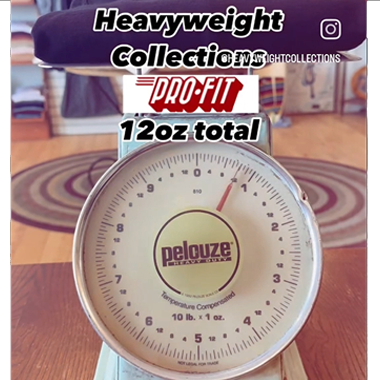
Standard retail t-shirts typically weigh 4.5-5.3 oz per square yard of fabric. Fast fashion brands often use 3.5-4.5 oz fabric. Premium brands range from 5.5-6.5 oz. Super heavyweight specialty t-shirts like ours weigh 7.5 oz. The total weight of a size Large t-shirt is approximately 6-10 ounces depending on fabric weight (a 5 oz t-shirt weighs about 7.5-8 oz total, while a 7.5 oz t-shirt weighs about 11-12 oz total).
Is 5.3 oz heavyweight?
No, 5.3 oz is considered medium weight, just below the heavyweight threshold of 5.5 oz. While 5.3 oz is heavier than standard fast fashion (4-4.5 oz), it doesn't quite reach the durability and drape characteristics that define true classic heavyweight t-shirts. The 0.2 oz difference between 5.3 oz and 5.5 oz may seem small, but it represents the transition point where fabric behavior changes significantly.
What does GSM mean for t-shirts?
GSM stands for "grams per square meter" and is an alternative way to measure fabric weight used internationally. To convert: 1 oz/yd² = approximately 33.9 GSM. A 6.0 oz t-shirt equals about 203 GSM. Heavyweight t-shirts are typically 185+ GSM (5.5+ oz), while super heavyweight starts at 240+ GSM (7+ oz).
Do heavyweight t-shirts shrink more than lightweight?
Not necessarily. Shrinkage depends on whether the fabric is pre-shrunk, not on weight. Heavyweight t-shirts that are properly pre-shrunk (like ours through garment dyeing) actually shrink LESS than lightweight alternatives—typically under 1% compared to 5-8% for non-pre-shrunk lightweight tees. The key is the manufacturing process, not the weight.
Are heavyweight t-shirts too hot for summer?
No. Quality heavyweight 100% cotton t-shirts are actually comfortable in summer because the extra weight prevents the fabric from clinging to your skin when you sweat. The thickness creates air circulation between fabric and skin. Heavyweight cotton breathes well and wicks moisture effectively. The misconception comes from synthetic heavyweight fabrics, which DO trap heat.
What's the difference between 6 oz and 7 oz t-shirts?
A 1 oz difference is very noticeable. A 7 oz t-shirt will feel approximately 15-17% heavier, drape more substantially, be more opaque (especially in lighter colors), resist wrinkles better, and typically last 2-3 years longer than a 6 oz shirt. The 7 oz tee will also maintain its shape through more wash cycles and develop a better vintage patina as it ages.
Why do some heavyweight t-shirts cost $40-50?
Price reflects material cost (40-60% more fabric than lightweight), manufacturing complexity (heavyweight requires specialized equipment), higher labor costs (USA-made vs overseas), quality construction (reinforced seams, better stitching), pre-shrinking processes, and premium cotton sourcing. A $40 heavyweight t-shirt that lasts 7-10 years costs less per wear than a $12 lightweight shirt replaced every year.
Can you feel the difference between 7 oz and 7.5 oz?
Most people cannot detect a 0.5 oz difference by feel alone. The difference is about 6-7%, which is within the margin of perception for most wearers. However, the cumulative effect of multiple 0.5 oz increases becomes noticeable—the jump from 6.0 oz to 7.5 oz (1.5 oz total) is very apparent.
What's the heaviest t-shirt fabric available?
Production heavyweight t-shirts typically max out at 8-10 oz for practical wearability. Some specialty workwear and heritage brands make 10-12 oz "t-shirts" that are closer to sweatshirt weight. Beyond 8 oz, the fabric becomes very stiff initially and requires extensive breaking in. Our 7.5 oz weight hits the optimal balance of substantial feel while maintaining t-shirt comfort and drape.
The Bottom Line: Why Heavyweight Matters
Fabric weight isn't just a specification—it's a predictor of how your t-shirt will perform throughout its entire lifespan. Understanding the difference between 4 oz and 7.5 oz fabric empowers you to make informed purchasing decisions based on value, not just price.
Key takeaways:
- 5.5+ oz qualifies as heavyweight
- 7+ oz is super heavyweight (our specialty)
- Heavier = more durable, but also more expensive upfront
- Cost per wear favors heavyweight significantly
- Heavyweight works year-round when properly constructed
- Weight alone doesn't guarantee quality—construction matters too
At Heavyweight Collections, we chose 7.5 oz because it represents the sweet spot: substantial enough for maximum durability and structure, yet comfortable enough for all-day wear. Combined with our garment dyeing process, reinforced construction, and 100% American cotton, our 7.5 oz t-shirts deliver the quality our customers expect.
Ready to experience true heavyweight quality?
Shop Our 7.5 oz Heavyweight T-Shirt Collection →
About the Author
Jay Durkee is the founder of Heavyweight Collections and a second-generation garment manufacturer based in San Clemente, California. With over 40 years of experience in apparel production, Jay has specialized in heavyweight cotton t-shirts and the technical aspects of fabric construction that determine quality and longevity.
Related Articles: