

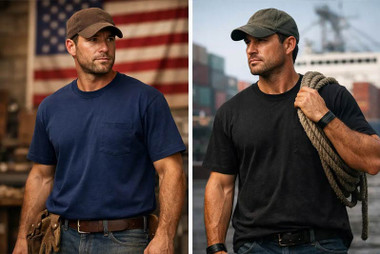
Pocket vs Non-Pocket T-Shirts
Posted by Jay Durkee, Founder on Sep 9th 2026
When you're shopping for a quality heavyweight t-shirt, there's a decision most people don't think about until they're standing in front of product options: pocket or non-pocket? It seems like a small detail. But it changes everything about how a shirt looks, feels, and functions in your daily life. After 30+ years of making t-shirts in Southern California, I've learned that this single choice defines your wardrobe. Get it right, and you have a versatile staple. Get it wrong, and you're buying something that doesn't fit your actual life. Let me break down the pocket vs non-pocket decision so you can choose what actually works for you.
Why This Decision Matters More Than You Think
A pocket isn't just a functional detail. It's a style choice, a practicality question, and a statement about what you actually need from your clothing.
Some people think pockets are essential. Others think they ruin the clean line of a t-shirt. Most people just buy what's available and don't think about it.
But here's what I've noticed after three decades: the pocket t-shirt vs non-pocket choice determines whether you actually wear the shirt or it sits in your drawer.
Pocket T-Shirts: Benefits & When to Choose Them
The Functionality Argument
A pocket shirt gives you somewhere to put things. This sounds obvious, but it changes your entire daily experience.
What you can do with a pocket:
- Keep your phone accessible without a bag
- Carry keys, wallet, or small items hands-free
- Maintain a small amount of storage without needing cargo pants or a jacket
If you're someone who moves around—commuting, running errands, working in an office—a pocket shirt means you're not fumbling for your stuff or carrying a bag just for your phone.
The Casual Aesthetic
A chest pocket adds visual interest. It breaks up the simplicity of a plain t-shirt and gives it a slightly more intentional, put-together look.
This is subtle but real. Compare:
- Pocket tee: Looks deliberate. Minimal but intentional design choice. Works with jeans or casual pants.
- Non-pocket tee: Looks clean/minimal. But can feel blank or incomplete if it's your only visual anchor.
The pocket gives you a design element that doesn't require graphics, logos, or fussy details.
Best Use Cases for Pocket T-Shirts
- Daily wear/work casual: You need somewhere for keys, phone, or small items
- Outdoor activities: Hiking, yard work, casual outings where you need accessibility
- Business casual: Worn under a jacket or on its own, looks slightly more intentional
- Travel: You need functional storage without a bag
- Personal preference: You just like having the option
Pricing: Pocket T-Shirts
At Heavyweight Collections, a pocket t-shirt is $2-3 more than the non-pocket version (because there's literally more construction). So:
- Short sleeve pocket: $30
- Long sleeve pocket: $35 (Limited Availability so shop in season)
- XL/XXL: Add $2
That extra cost is worth it if you'll actually use the pocket. It's not worth it if pockets don't fit your lifestyle.
---
Non-Pocket T-Shirts: Benefits & When to Choose Them
The Pure Aesthetic
A non-pocket t-shirt is clean. Simple. No visual interruption. It's just fabric and fit, nothing else.
This is powerful if you care about minimalism or building a cohesive wardrobe where every piece is intentional and uncluttered.
The psychological difference:
- A pocket tee = "casual working tee"
- A non-pocket tee = "clean, intentional basic"
If you're wearing it under a jacket, this distinction disappears. But wearing it solo, non-pocket reads cleaner.
Versatility Across Contexts
Without a pocket, a t-shirt works in MORE contexts:
- Casual (jeans, shorts)
- Semi-formal (under a blazer or sport coat)
- Layering piece (under an open shirt)
- Athletic-adjacent (worn with athletic shorts or joggers)
- Minimalist aesthetic (stands alone without visual clutter)
A pocket tee looks specifically "casual." A non-pocket tee feels more universally appropriate.
Fit & Proportion
This is technical but important: a pocket adds visual weight to the chest area.
If you have a larger chest or you're self-conscious about that area, a pocket can emphasize it. A non-pocket tee keeps the proportions balanced without visual emphasis.
This matters less with oversized fits (like our Classic Fit), but it definitely matters with our Pro Fit (slimmer cut).
Best Use Cases for Non-Pocket T-Shirts
- Layering pieces: Worn under jackets, shirts, or sweaters
- Minimalist aesthetic: You want zero visual clutter
- Versatility: You want one shirt that works everywhere
- Athletic wear: Worn with athletic bottoms or under athletic jackets
- Professional casual: Worn with a blazer or under an open shirt
- Cost conscious: You want the lower price point
Pricing: Non-Pocket T-Shirts
Non-pocket is our baseline price:
- Short sleeve: $28
- Long sleeve: $32
- XL/XXL: Add $2
$2-3 savings per shirt. Over a collection of 5-10 tees, that adds up.
---
Pocket vs Non-Pocket: Direct Comparison
| Factor | Pocket T-Shirt | Non-Pocket T-Shirt |
|---|---|---|
| Functionality | Storage for phone, keys, wallet | No storage; need separate bag |
| Aesthetic | Casual, intentional, design element | Clean, minimal, versatile |
| Visual Weight | Adds emphasis to chest area | Balanced proportions |
| Layering Ability | Good under open shirts; slight visual interest | Better under jackets; cleaner look |
| Best Fit for Pocket | Classic Fit (boxy) emphasizes pocket naturally | Pro Fit (slim) benefits from clean lines |
| Context Versatility | Reads "casual"; best for daily wear | Works everywhere; more versatile |
| Styling | Stands alone easily; interesting enough solo | Needs to be part of outfit; less standalone |
| Price | Short: $30 | Long: $35 | Short: $28 | Long: $32 |
| Lifespan | Same (7-10 years with care) | Same (7-10 years with care) |
---
Our Fits & How Pocket Changes Them
The pocket vs non-pocket choice interacts differently with our three fit options. Here's how to think about it:
Classic Fit (Boxy/Oversized)
With pocket: The pocket becomes a natural design feature. The generous fit makes it look intentional, not tight or awkward. Pocket reads well here.
Without pocket: The clean lines emphasize the fit itself. You get the full oversized aesthetic without visual interruption.
Best choice: Either works, but pocket gives you more visual interest. Non-pocket gives you more versatility.
Our recommendation: If you're building a capsule wardrobe, get BOTH. Classic Fit pockets for everyday wear, Classic Fit non-pockets for layering.
Pro Fit (More Slim/Modern)
With pocket: The pocket sits more prominently on a slimmer chest. This can be an intentional design choice (modern, styled) or visually busy, depending on preference.
Without pocket: Clean lines shine. The slim fit looks intentional and modern without the pocket adding visual weight.
Best choice: Non-pocket. The slim fit reads better without the pocket breaking the line.
Our recommendation: For Pro Fit, lean toward non-pocket unless you specifically want that modern-casual pocket work-shirt.
Tall Fit (For 6'2"+)
With pocket: Proportions work the same as Classic Fit—the pocket is a natural design element.
Without pocket: Clean lines let you focus on getting the proportions right (longer body, longer sleeves).
Best choice: Either works. Depends on your personal preference.
Our recommendation: If you want functional storage, pocket. If you want maximum versatility, non-pocket.
---
Building Your Wardrobe: Pocket + Non-Pocket Strategy
Here's what I recommend if you're serious about building a quality t-shirt collection:
The Minimalist Collection (2-3 shirts)
Choose ONE and stick with it.
Option A (Functional): 2-3 pocket tees, same color. Wear everywhere, don't overthink it.
Option B (Versatile): 2-3 non-pocket tees, same color. Works in any context.
The Balanced Collection (5-7 shirts)
Mix both types:
- 2-3 pocket tees (daily wear, casual activities)
- 2-3 non-pocket tees (layering, versatility)
- 1-2 in different colors (White, Black, Navy)
This gives you functional storage when you need it AND clean versatility when you don't.
The Complete Collection (10+ shirts)
Build intentionally:
- Classic Fit pockets in 3-4 colors (White, Black, Navy, Charcoal) — everyday wear
- Classic Fit non-pockets in 2-3 colors — layering/versatility
- Pro Fit non-pockets in 2-3 colors (if you like slimmer fit) — modern styling
- Long sleeves in whichever feels right (pocket or non-pocket)
This covers every scenario: casual wear, layering, business casual, travel. You will always look great!
---
The Hidden Factor: Fabric Weight Makes It All Better
Here's something most people don't realize: the pocket vs non-pocket question is moot if the fabric is garbage.
A pocket on a thin, cheap t-shirt looks cheap. It will sag the minute you use the pocket for anything. A pocket on heavyweight fabric looks intentional, holds up and is large enough to be useful.
Same with non-pocket: a clean non-pocket tee on thin fabric still feels flimsy. On heavyweight fabric, it feels premium.
Our 7.5 oz garment-dyed construction means:
- Pockets sit well and look intentional (not cheap)
- Non-pockets look substantial and premium (not thin)
- Either choice works because the base quality is there
This is why the pocket vs non-pocket decision isn't really about the pocket. It's about your lifestyle and aesthetic preference. The quality underneath handles the rest.
---
Frequently Asked Questions
Will a pocket t-shirt still look good in 5 years?
Yes. Because of our garment-dye construction and 7.5 oz fabric, the pocket doesn't degrade differently than the rest of the shirt. It ages beautifully, just like the body of the shirt.
Does a pocket affect how a t-shirt fits?
Minimally. The pocket adds about 2-3 oz of fabric to the chest, which you won't notice. It doesn't change the fit—it just adds a detail.
Can I wear a pocket tee under a blazer?
Absolutely. Professional look? Go non-pocket. Casual professional? Pocket works fine under a blazer or sport coat.
Which is better for a capsule wardrobe?
Non-pocket. It's more versatile and works in more contexts. But a quality pocket tee is versatile enough for most people, so don't let this paralyze your decision.
Are pocket and non-pocket the same price difference across all sizes?
Yes. Pocket is always $2-3 more, regardless of size or sleeve length.
Do I need both pocket and non-pocket, or can I just choose one?
You can choose one if you have a clear lifestyle. But most people benefit from having both—pockets for daily wear, non-pockets for versatility.
What colors look best with a pocket tee?
All of them. But White and Navy are most versatile. Black is classic. Charcoal and Cement are slightly more interesting. Choose based on what you'll actually wear.
Long sleeve pocket or non-pocket?
Same logic applies. If you wear long sleeves for outdoor work or casual activities, pocket makes sense. If you wear them for layering, non-pocket is better.
---
The Bottom Line: Make It Simple
Here's the truth: both are good. Both will last 7-10 years. Both look great in 7.5 oz heavyweight fabric.
The real question is: how do you actually live?
Do you need somewhere to put your phone and keys? Pocket.
Do you need maximum versatility across different contexts and outfits? Non-pocket.
Not sure? Get both. Start with one of each in your favorite color, wear them for a month, and see which one you reach for more.
That's your answer.
Explore our full collection of pocket and non-pocket heavyweight t-shirts: Classic Fit Heavyweight Tees (Pocket & Non-Pocket)
About the Author
Jay Durkee is the founder of Heavyweight Collections, a family-owned t-shirt manufacturer based in San Clemente, California. With over 30 years of experience making heavyweight garment-dyed t-shirts, Jay specializes in the details that most people overlook—and that make all the difference in longevity, fit, and everyday wearability.
Related Articles: